
Quick Summary
Most pool construction budgets fail on costs missing from the quote, such as dirt hauling, retaining walls, caliche, private utility lines, and permits. Reviewing the scope for exclusions, verifying site conditions, and confirming responsibility for buried utilities in writing before you sign protects you from surprise change orders.
- Assume any cost not listed as included in the quote will be billed later as a change order.
- Confirm in writing how many cubic yards of dirt will be removed and who pays disposal.
- Price caliche and rock per hour, per yard, or as a defined change order, not as a vague allowance.
- Private lines on your side of the meter are often not marked by 811, so assign who locates them.
- Compare every bid line by line across site work, utilities, permits, and allowances, not just the total.
Table of Contents
- Why Pool Construction Quotes Miss Costs
- Site Preparation Costs: Excavation, Hauling, and Soil Conditions
- Utility Locating and Who Pays for Damage
- Pool Permits and Inspections: What to Budget For
- Pool Construction Quote Checklist: Line Items to Compare
- Building a Contingency Fund by Cost Category
- Reviewing Your Pool Construction Contract Before You Sign
- Frequently Asked Questions
Pool construction budgets rarely fail because of the pool itself. They fail on the costs nobody wrote down: the dirt that has to leave the lot, the retaining wall a sloped yard demands, the utility line nobody marked. Knowing where those surprises hide is the difference between a quote you can trust and a bill that doubles halfway through the build. This guide walks through the hidden costs that often appear in custom pool projects, and how to spot each one before you sign.
Most homeowners assume a pool quote covers everything between the first shovel and the final fill. It usually doesn't. A quote is a snapshot of what the builder can see and price on day one, and anything outside that view is either excluded or estimated. Read the scope carefully and ask what is not included.
Why Pool Construction Quotes Miss Costs
A quote is only as complete as the information behind it. Many quotes are built from a short site visit, a sketch, and a few assumptions about soil and access. When those assumptions turn out to be wrong, the cost shifts to the owner.
Common gaps include:
- Unstated exclusions: Dirt hauling, permits, or landscaping restoration left off the page
- Unverified site conditions: Soil, grade, or buried debris that was never tested
- Allowances: Lump sums for items like tile or decking that are later exceeded
- Vague scope language: Phrases like "standard finishing" with no clear definition
Watch out: If a quote lacks a clear exclusions list, assume the excluded items will be billed later as change orders.
Site Preparation Costs: Excavation, Hauling, and Soil Conditions
Site work is where many pool budgets first break, and in Amarillo the ground itself is the reason. The Texas Panhandle sits on soils that behave very differently from the sandy or loamy profiles many national pool guides assume.
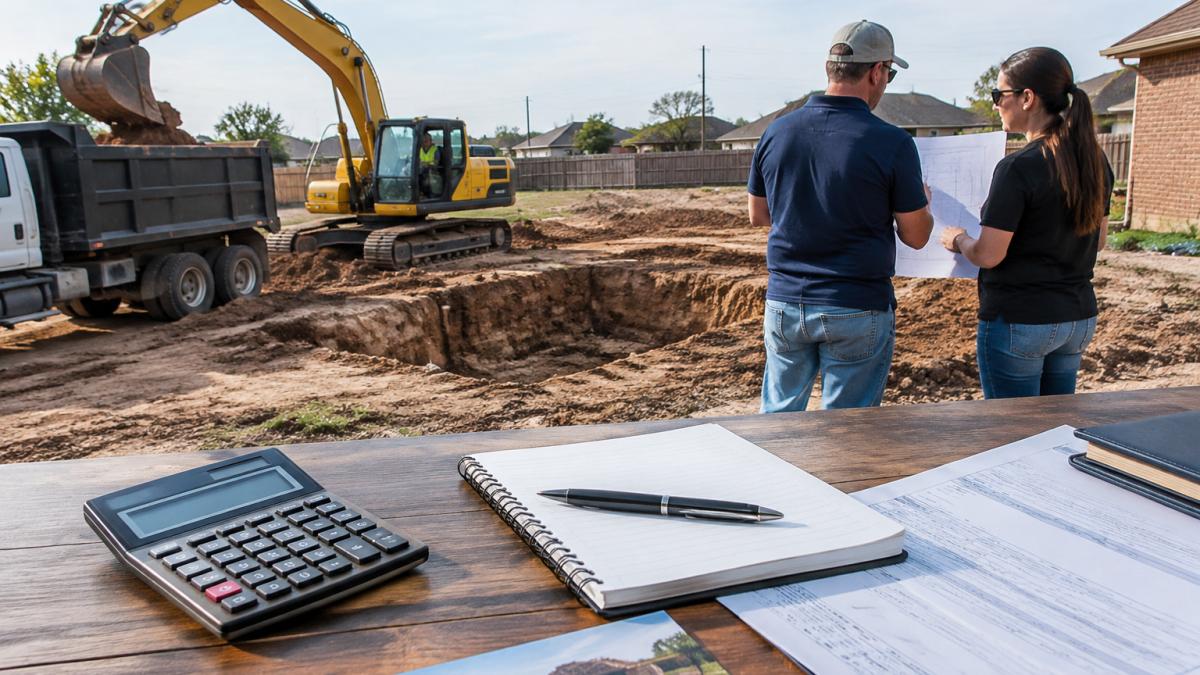
Amarillo-area lots commonly run into expansive clay and caliche, a cemented calcium-carbonate layer that can be soft in one spot and pickaxe-hard a few feet away. Expansive clay swells when it wets and shrinks when it dries, which matters for how the pool shell is engineered, how the deck is tied to the shell, and how backfill is compacted. Caliche can slow excavation, require different equipment, and change how much material actually has to leave the site. None of that shows up in a generic per-square-foot pool price.
Dirt Removal and Hauling
Dirt removal is one of the most underestimated line items on any pool quote. Excavation produces far more material than most homeowners picture, and the disposal cost depends on the distance to an approved site, the number of loads, and whether the soil is clean enough to accept. Browse our custom pool construction services to see how site work is included in a build.
Ask your builder to answer these questions in writing before you sign:
- How many cubic yards of material will be removed, and how was that number calculated from the pool dimensions and depth?
- Where will the dirt go, and who pays the disposal or tipping fee?
- Is there a plan to spread or reuse excess soil on the property, and does that plan account for grade and drainage?
- Does the quote include hauling for all of the material, or only the first few loads?
- If caliche or rock is encountered, how is that priced, per hour, per yard, or as a change order?
If the answer to the hauling question is "only part," you have found a likely change order. If the answer to the caliche question is vague, treat that as an unpriced risk.
Retaining Walls and Sloped Yards
A sloped backyard changes the project. Retaining walls may be needed to hold back soil around the pool and deck, and those walls add material, labor, engineering, and sometimes permitting. Walls are rarely included in a basic pool price, and on Panhandle lots with grade change they can be a significant line item.
Check whether your quote addresses grade changes at all. A flat-yard price applied to a sloped lot is one of the most common sources of surprise bills. Ask whether the wall is engineered, who stamps the design, and whether the wall's drainage is included, because a wall without drainage can fail and become a second cost.
Watch out: A quote that lists "rock" or "caliche" as an allowance rather than a defined unit price leaves the most variable site cost in the builder's favor.
The table below summarises the site-work items that most often drive pool budgets beyond the quoted price.
| Cost item | Risk | What to confirm |
|---|---|---|
| Dirt hauling | Often underestimated | Cubic yards, disposal site, fee payer |
| Caliche | Variable excavation cost | Priced per hour, yard, or change order |
| Expansive clay | Affects shell and backfill | Engineered design and compaction |
| Retaining walls | Needed on sloped lots | Engineered, drained, and priced separately |
| Private utility lines | Often unmarked by 811 | Who locates and who pays for damage |
| Permits and re-inspections | Easily left out | Fees verified with local building department |
Utility Locating and Who Pays for Damage
Buried utilities are a real risk on any dig, and the risk is higher than most homeowners assume because the 811 system does not mark everything. Gas, water, sewer, electric, and communications lines can all run through the area where a pool will go, and hitting one can cause injury, service outages, and expensive repairs.
The critical distinction is public versus private lines. The free 811 "call before you dig" service in Texas marks member-owned public utilities up to the meter or service point. Lines on the homeowner's side of the meter, irrigation lines, pool and spa lines from a previous pool, landscape lighting conduit, private water or sewer lines, and lines to outbuildings, are typically the property owner's responsibility to locate and mark.
Before excavation begins, confirm the sequence in writing:
- The builder or owner submits the 811 request and waits the required notice period before digging.
- Public utilities mark their lines, and the marks are photographed and dated.
- Private lines are located separately, by the owner, the builder, or a private locating service, and the cost of that service is assigned in the contract.
- The excavation crew respects the tolerance zone around each mark and hand-digs where required.
Then clarify responsibility. Ask who pays if a utility is damaged during excavation, whether that responsibility is capped, and whether it is written into the contract rather than left to a verbal understanding. Ask the same question for private lines specifically, because that is where most disputes originate. Many contracts are silent on private lines, and silence usually favors the party holding the invoice.
Watch out: If your contract says only that the builder "will call 811," it has not assigned responsibility for private lines, damage repair, or service interruption, three costs that can land on the homeowner.
Pool Permits and Inspections: What to Budget For
Permits and inspections are a legitimate cost, and they are often left out of early estimates or listed as a single unclear line. Depending on your city and county, a pool project can require building, electrical, plumbing, and gas permits, along with several inspection visits during construction.
Permit fees vary by jurisdiction and project scope, so verify any figure with the local building department. Also ask whether the builder handles permit applications and scheduling, and whether re-inspection fees are included if a visit fails.
Inspections can also affect the schedule. A failed inspection may stop work until corrections are made, which can extend the timeline and add labor costs.
Pool Construction Quote Checklist: Line Items to Compare
When you compare quotes, don't stop at the bottom-line total. Two quotes can look similar on paper and differ widely in what they cover. Build a simple comparison sheet and fill in each line for every bid.
Use this checklist:
- Excavation volume and method
- Dirt hauling and disposal
- Soil testing or engineering
- Retaining walls, if needed for grade
- Utility locating and damage responsibility
- Permits, inspections, and re-inspection fees
- Concrete and decking quantities
- Equipment, plumbing, and electrical scope
- Landscaping and yard restoration
- Allowances and what happens when they are exceeded
- Warranty terms and who services equipment
A quote that leaves several of these lines blank is not a finished quote. Ask for clarification before you compare prices.
Building a Contingency Fund by Cost Category
A contingency fund is money you set aside for surprises. Because site conditions and inspections are hard to predict, most experienced owners plan for some level of unexpected cost. The right percentage depends on your lot, your budget, and how much risk you can absorb.
A practical approach is to set a separate reserve for each risk category rather than one lump sum:
- Site work: Reserve more if the lot is sloped, the soil is untested, or access is tight
- Utilities: Reserve for repair if the dig area is crowded with existing lines
- Permits and inspections: Reserve for re-inspection or added requirements
- Finishes and allowances: Reserve for upgrades if tile or decking allowances are low
Keep the fund in cash or a dedicated account so it is available when a change order appears.
Reviewing Your Pool Construction Contract Before You Sign
The contract controls what you actually pay. A clear quote can still lead to a costly project if the contract is vague about change orders, payment milestones, or completion dates.
Before signing, check these points:
- Change orders: How are added costs approved, priced, and documented?
- Payment schedule: Are payments tied to completed milestones rather than dates?
- Exclusions: Does the contract repeat the exclusions from the quote?
- Schedule and delays: What happens if weather or inspections delay the work?
- Warranty and service: What is covered, for how long, and who responds to a call?
Reeder Outdoor Living is a family-run business with direct accountability, so the people who sign your contract are the people who build your pool and answer your calls afterward. If you want a line-item estimate that spells out every category above, request a free consultation and we will walk through the scope with you before you commit. For help planning the budget itself, see how financing options can cover the full project.
Last Updated: November 4, 2026
Frequently Asked Questions
What costs are often left out of a pool construction quote?
Common omissions include excavation and dirt hauling, retaining walls on sloped lots, utility relocation, drainage work, electrical and gas runs to equipment, permit and inspection fees, decking and patio concrete, landscaping and yard restoration, and fencing. Ask the builder to list each of these as either included or excluded. A quote that does not address them is likely to produce change orders once construction begins.
What should a pool construction contract include?
A pool construction contract should define the project scope, a line-item price for each phase, payment milestones tied to completed work, the allowance amounts for tile, coping and equipment, the permit responsibility, the construction schedule with delay terms, the warranty terms, and the process for change orders. Confirm that every exclusion mentioned in the quote also appears in the contract so nothing shifts to you later.
How much contingency should I budget for pool construction?
A contingency reserve can cover unexpected site conditions, utility surprises and design changes. Projects with sloped yards, unknown soil or older utility lines may warrant more. Keep the contingency in a separate account so it is available when an unexpected cost appears, rather than being absorbed into other budget categories.
Are permits and inspections included in pool construction costs?
Not always. Some builders include permit fees in their quote, while others pass them through as a separate line item. Confirm who pulls the permit, who pays the fee, and how many inspections the project requires, including electrical, plumbing and barrier inspections. Ask for written confirmation of these details in the contract before work begins.
