
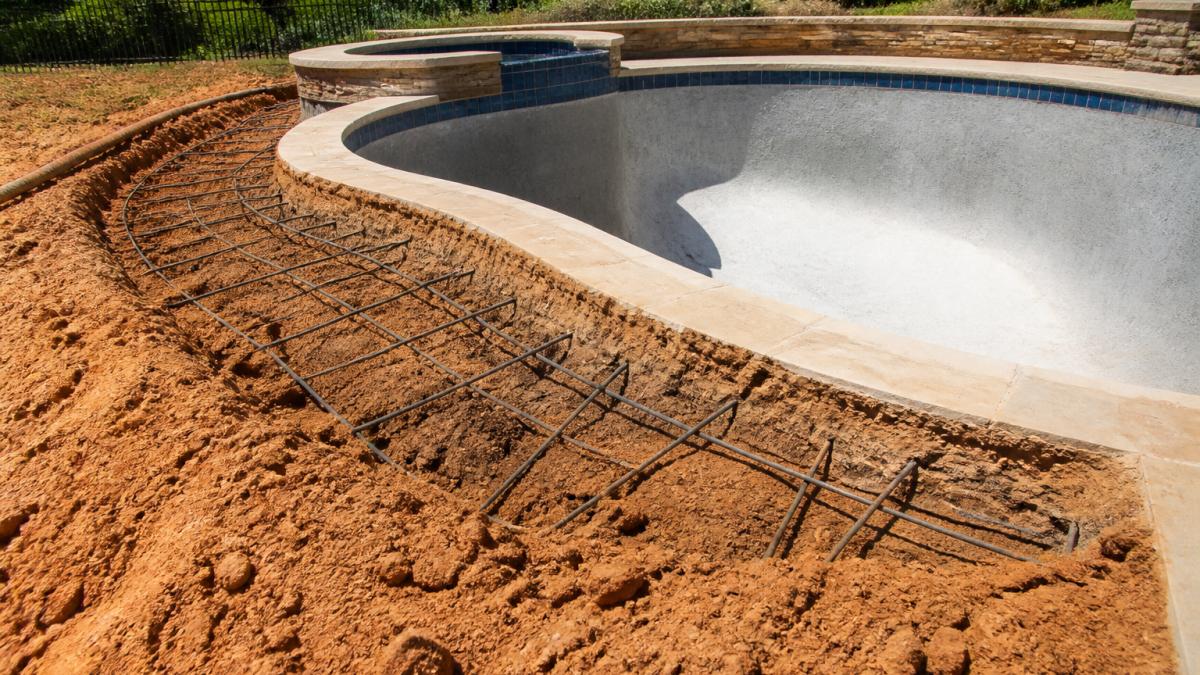
Last Updated: October 23, 2026
Quick Summary
To prevent pool cracks clay soil causes, you must manage soil moisture consistently, install proper drainage, and build on a compacted, moisture-conditioned subgrade specified by a geotechnical engineer. Clay shrinks when dry and swells when wet, creating uneven pressure on your pool shell; controlling this movement through site prep, free-draining backfill, and perimeter drains stops most cracks before they start.
- A geotechnical report before excavation is the cheapest insurance and identifies clay plasticity, swell potential, and required foundation depth.
- Compact the subgrade in 6 to 8 inch lifts to 95% maximum dry density and use free-draining backfill with filter fabric against the shell.
- Install a perimeter drain pipe around the pool footprint, wrapped in filter fabric, to intercept groundwater before it reaches the concrete.
- Water the soil 6 to 12 inches deep two to three times per week during dry spells to keep moisture steady, not swinging between bone dry and saturated.
- Monitor cracks monthly with photos and measurements; cracks wider than 1/8 inch that grow larger each season need professional evaluation.
Table of Contents
- Why Pool Cracks Happen in Expansive Clay Soil
- Pool Construction on Expansive Clay Soil
- Pool Drainage Around a New Pool
- Why Is the Concrete Around My Pool Cracking
- Pool Deck Crack Prevention and Maintenance
- When to Call a Pool Professional
- Frequently Asked Questions
Why Pool Cracks Happen in Expansive Clay Soil
To prevent pool cracks clay soil causes, you must understand that pool cracks in Texas clay soil happen because of soil movement.
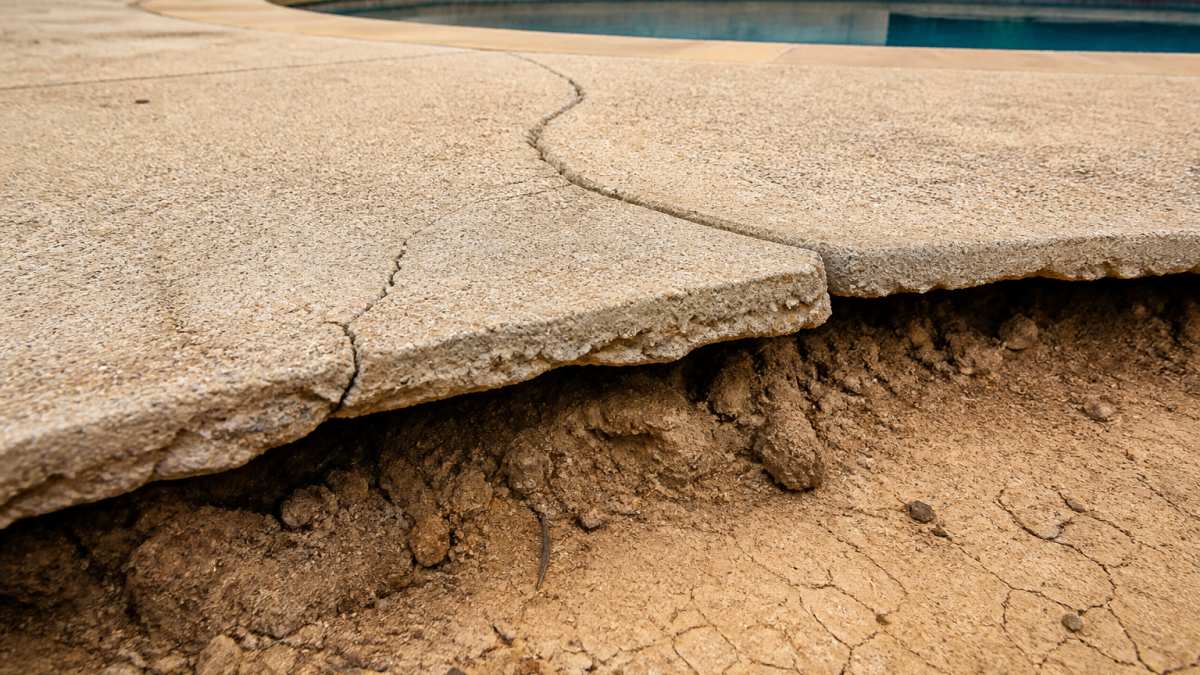
How Clay Soil Swells and Shrinks
Expansive clay contains minerals that absorb water like a sponge, expanding as moisture increases and shrinking as it decreases, repeatedly, year-round, especially in Texas. The expansion isn't uniform: one part of your yard may dry faster than another, creating uneven pressure on the shell and deck.
Common signs of soil movement:
- Cracks that grow wider each season
- Concrete that slopes or sinks
- Gaps between the pool and deck
Texas Heat and Drought's Role in Soil Movement
Texas summers dry and shrink the topsoil first; monsoon rains then saturate it again, and this rapid shift stresses your pool structure. Drought years make it worse: months of dry conditions shrink the soil severely, then rain swells it fast. The key is managing soil moisture consistently.
Pool Construction on Expansive Clay Soil
Building a pool on expansive clay is a geotechnical problem before it is a concrete problem. Most cracking that shows up in year three or year ten was designed in during excavation and backfill.
Geotechnical Evaluation Before Excavation
A geotechnical report is the cheapest insurance on the project. A licensed engineer takes borings around the pool footprint, classifies the clay, and recommends a foundation and drainage approach. It typically addresses:
- Plasticity index (PI): Higher PI means more swell-shrink movement. Clay with a PI above roughly 30 is generally treated as highly expansive and drives more conservative design.
- Swell potential: Measured in a lab by consolidating a sample and allowing it to wet up. This tells the designer how much heave to expect under the shell.
- Seasonal moisture variation: The depth of the active zone, the soil layer that wets and dries with the seasons, determines how deep stabilization or moisture control must go.
Skipping this step is common on residential pools and is the single most frequent reason a shell cracks in its first decade. The report also gives the builder a defensible basis for the shell design if a crack becomes a warranty dispute.
Site Preparation and Soil Stabilization
Site prep on expansive clay means removing what makes moisture uneven, then building a uniform, compacted working surface.
- Strip organics and root zones. Topsoil, roots, and old landscaping hold water and decay, leaving voids under the shell. Remove them to the depth the geotechnical report specifies.
- Scarify and moisture-condition the subgrade. Work the clay near optimum moisture for compaction, not bone dry, not saturated. The geotechnical report gives the target range.
- Compact in lifts. Place and compact the subgrade in lifts (commonly 6 to 8 inches loose) to the density the engineer specifies, typically 95% of maximum dry density per ASTM D698 (Standard Proctor), verified by a nuclear gauge or sand cone test.
A practical rule: the subgrade under a pool shell should be as uniform as the concrete above it. Any soft spot, root void, or uncompacted backfill patch becomes a point where the shell bridges and eventually cracks.
Shell Design and Reinforcement
A pool shell on expansive clay must resist hydrostatic pressure from the soil and the bending that comes from differential movement. The details that matter most:
- Reinforcement: Steel-reinforced concrete is standard. Rebar size, spacing, and lap lengths should follow the engineer's design; a common residential pattern is a grid of #3 or #4 bar at 8 to 12 inches on center, with extra steel at wall-floor junctions and around skimmers, lights, and main drains.
- Concrete thickness and cover: Shell walls are commonly 6 to 8 inches thick, with adequate cover over the steel. Too little cover invites corrosion and cracking.
- Control joints: In the shell, joints go where stress concentrates, at changes in geometry and wall-to-floor transitions. On the deck, space control joints every 8 to 12 feet and align them with the shell's joint pattern where possible.
The shell should tolerate minor movement, not be rigidly locked to a moving soil mass. Over-constraining it, say, tying it rigidly to a deep, unyielding pier system, can transfer soil stress into the concrete and cause the very cracking the design meant to prevent.
Backfill and Drainage Details That Prevent Cracks
Backfill is where many pool cracks begin, making it critical to prevent pool cracks clay soil creates through poor drainage design. Clay backfill against the shell traps water, swells, and pushes on the wall. The fix is a drainage-friendly backfill envelope and a path for water to leave.
- Use free-draining backfill. Sandy or engineered granular backfill against the shell, separated from native clay by filter fabric, lets water drain down rather than sit against the concrete.
- Install a perimeter drain. A perforated drain pipe in a gravel trench around the pool footprint, wrapped in filter fabric and outlet to daylight or a sump, intercepts groundwater before it reaches the shell.
- Compact backfill in lifts. Loose backfill settles and creates voids; compacted backfill supports the deck and reduces differential movement between shell and deck.
Construction Choices That Raise or Lower Crack Risk
Two pools on the same street can have very different crack histories depending on construction choices. Higher-risk: skipping geotechnical testing, backfilling with native clay, omitting perimeter drainage, placing the shell on an uneven or uncompacted subgrade, and under-reinforcing at penetrations. Lower-risk: a geotechnical report, moisture-conditioned and tested subgrade, free-draining backfill with filter fabric, a perimeter drain, a reinforced shell with proper cover and waterstop detailing, and a deck graded away from the pool.
Pool Drainage Around a New Pool
Drainage is your best defense against soil movement. Water around your pool causes swelling; water under it causes settlement. Managing both prevents most cracking problems.
Managing Surface Runoff and Groundwater
Surface water should flow away from your pool. Slope the ground at least 2% away from the pool so water never pools near the shell.
Underground water is trickier. Groundwater naturally moves toward low spots, and your pool is a low spot. A perimeter drain system intercepts it before it reaches your pool:
- Drain pipe installed around the pool perimeter
- Gravel layer to allow water flow
- Landscape fabric to prevent clogging
Less saturation means less swelling and fewer cracks.
Protecting Underground Lines and Backfill
Water, sewer, and irrigation lines near your pool need protection, because the backfill around them affects how water moves. Use sandy or engineered backfill rather than clay-heavy soils, compact it in layers, and keep it away from the pool shell. Poor backfill traps water near the shell; good backfill drains it away and keeps the surrounding soil from becoming saturated.
Why Is the Concrete Around My Pool Cracking
Cracks appear for different reasons. Understanding the type helps you fix it correctly.
Deck Cracks vs. Shell Cracks
Deck cracks usually follow control joints, straight, narrow, and predictable. Concrete shrinks as it cures, and control joints direct that shrinkage, so cracks that follow these joints are not a structural problem.
Shell cracks are different: random, often wider, and possibly leaking. They indicate soil movement or structural stress. Deck cracks that don't follow joints suggest soil movement, uneven settlement bends the concrete until it cracks.
Control Joints and Crack Monitoring
Control joints are intentional weak points that let concrete move without cracking randomly. Space them every 8-12 feet on decks.
Monitor your cracks regularly:
- Take photos monthly during summer
- Measure crack width with a ruler
- Note whether cracks grow wider or stay stable
Stable cracks that don't grow are usually not urgent. Growing cracks indicate ongoing soil movement and need professional attention.
Pool Deck Crack Prevention and Maintenance
Preventing deck cracks is mostly about keeping the soil under and around the deck at a stable moisture content and catching changes early. The routine below uses measurable thresholds so you're not guessing whether a crack is cosmetic or a sign of active soil movement.
Consistent Watering and Soil Moisture Management
Counterintuitively, the goal in dry months is not to keep the soil wet but to keep it from swinging between bone dry and saturated. Steady, moderate moisture produces far less swell-shrink movement than flood-and-drought alternation.
- Water in dry months, not in wet ones. During summer dry spells, run soaker hoses or drip irrigation around the deck perimeter two to three times per week, long enough to wet the soil 6 to 12 inches deep. Stop when the soil at that depth is moist but not muddy.
- Check moisture by hand before watering. Push a soil probe or hand trowel 6 to 12 inches down. If it is powder dry, water; if it is already moist, skip the cycle. Overwatering is as damaging as underwatering on expansive clay.
- Use a moisture meter for consistency. Read an inexpensive soil moisture meter at the same depth and spots each week. The absolute number matters less than the swing: soil that stays within a narrow band is doing its job.
Distinguishing Evaporation From a Leak
Water loss is normal; the question is whether it's evaporation or a leak. A simple bucket test separates the two:
- Fill a bucket with pool water and set it on a pool step so the water level inside matches the pool level outside.
- Mark the level inside and outside the bucket.
- Wait 24 hours with the pump running normally.
- Compare the drop. If the pool drops noticeably more than the bucket, you likely have a leak. If they drop about the same, it is evaporation.
Evaporation rises with heat, wind, and low humidity, so a pool can lose a surprising amount of water in a dry, breezy week with no leak at all.
If the bucket test points to a leak, stop adding water blindly. Compensating for a leak keeps the soil around the pool wetter than it should be, driving swelling and worsening the soil movement you're trying to prevent.
A Measurable Crack-Monitoring Routine
Cracks are information. This routine turns them into a trend you can act on.
- Photograph and date. Take a photo of each crack with a ruler or coin for scale, monthly during the dry season and after any major rain.
- Measure width. Record the widest point in fractions of an inch. Hairline cracks under about 1/16 inch that stay stable are usually cosmetic.
- Track length and offset. Note whether the crack is lengthening and whether one side is dropping relative to the other. Vertical offset is a stronger signal of soil movement than width alone.
Seasonal Maintenance Schedule
| Season | Action | Frequency |
|---|---|---|
| Spring | Inspect for winter cracks, clean deck, check that grading still slopes away from the pool | Once |
| Summer | Water soil on a dry-spell schedule, run the bucket test monthly, photograph and measure cracks | Weekly |
| Fall | Clean gutters and downspouts, confirm perimeter drain outlets are clear, prepare for winter moisture | Once |
| Winter | Monitor for freeze-thaw cracks, avoid de-icing salt on the deck, keep water from ponding | As needed |
Freeze-thaw cycles create their own cracks: water enters a hairline crack, freezes, expands, and widens it, repeating through winter. Sealing small cracks and grading water away is the practical defense.
When Monitoring Should Escalate
Escalate to professional evaluation when: a crack exceeds 1/8 inch and is growing; a new crack appears away from a control joint; the deck shows vertical offset or a trip hazard; the pool loses water faster than the bucket test can explain; the deck-to-shell joint opens noticeably; or you can't tell whether a crack is structural. A pool professional or geotechnical engineer can assess soil conditions, determine whether a crack is structural or cosmetic, and recommend repair or prevention before a small problem becomes a shell repair.
When to Call a Pool Professional
Some problems need expert help. Knowing when to call saves money and prevents bigger damage.
Call a professional if:
- Cracks grow wider than 1/8 inch
- You see new cracks appearing regularly
- The pool is losing water beyond normal evaporation
A professional can assess soil conditions and movement, identify whether cracks are structural or cosmetic, recommend repair or prevention strategies, install monitoring systems, and design drainage improvements.
At Reeder Outdoor Living, we work with homeowners to understand their pool's specific soil challenges.
Pool cracks in Texas clay soil are preventable. The key is understanding how clay moves with moisture changes.
Frequently Asked Questions
How can expansive clay soil cause a pool to crack?
Expansive clay absorbs water and swells, then dries and shrinks, creating constant pressure shifts beneath the pool shell and deck. During Texas summer drought, clay loses moisture and contracts, pulling the concrete apart. These repeated cycles of swelling and shrinkage stress the pool structure, especially if soil moisture is uneven. Proper drainage and consistent watering prevent extreme moisture swings that trigger cracking.
What drainage measures help protect a pool built on clay soil?
Install perimeter drainage around the pool to direct surface runoff away from the foundation. Use French drains or gravel beds to manage groundwater beneath the pool. Slope the deck away from the shell to prevent water pooling near the structure. Protect underground water and sprinkler lines with proper separation and sleeving. Ensure the backfill material is compacted correctly so water doesn't settle unevenly, which causes the soil beneath the pool to shift unpredictably.
How should I maintain soil moisture around a pool to prevent cracking?
Water the soil around the pool perimeter consistently, especially during dry spells and summer heat. Aim to keep soil moisture stable, avoid letting it dry completely or become saturated. Install irrigation or use soaker hoses to water the surrounding landscape evenly. Monitor soil conditions during drought periods and increase watering frequency if the ground pulls away from the pool deck. Consistent moisture prevents the extreme shrinkage that cracks concrete and stresses the pool shell.
When should I call a pool professional about a crack?
Contact a professional if you notice cracks wider than 1/8 inch, cracks that grow visibly over weeks, or water loss exceeding 1/4 inch per day. Hairline cracks in the deck may be cosmetic, but cracks in the shell itself require expert inspection to determine if the pool is leaking or if structural movement is ongoing. A professional can assess whether the crack is a control joint separation, freeze damage, or soil movement, each requiring different repairs.
